Tracking Matters Across eCourts, High Court Portals, and the Supreme Court Without Losing Your Mind
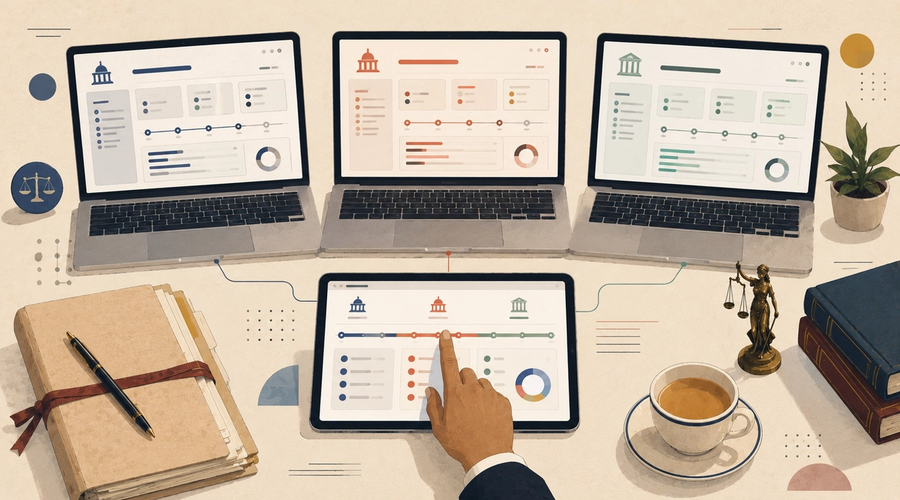
A senior advocate in Hyderabad opens her day with four browser tabs. The eCourts services portal for her District and Sessions Court matters. The Telangana High Court website for two writs and a criminal appeal. The Supreme Court case status portal for an SLP pending admission. And somewhere in a fourth tab, the NCLT or a tribunal site for an insolvency matter. She has not yet finished her first cup of coffee, and she has already typed the same CNR number into two different interfaces, refreshed one portal that has not updated since yesterday, and made a note in her diary to call the clerk because a next date is showing differently than what her junior wrote down.
This is not a workflow problem unique to one chamber. It is the structural reality of practicing law in India in 2026. The court system has digitized meaningfully. Every advocate handling matters across forums is, by default, running a manual integration project every single morning.
The Core Problem
A Digitized System That Was Never Designed to Be Unified The Indian judicial system runs on multiple parallel portals, each built by different teams at different times, each with its own conventions. The eCourts Services platform, designed and maintained by the National Informatics Centre under the eCommittee of the Supreme Court, covers most district and taluk courts across the country and works on a Case Number Record (CNR) identifier. Each High Court has its own portal with its own search logic and its own update rhythm. The Bombay High Court does it one way, the Delhi High Court another, the Madras High Court a third. The Supreme Court runs its own case status interface on sci.gov.in, separate from the eCourts ecosystem entirely. The National Judicial Data Grid aggregates statistics but is not where you check the next date on your own matter. Tribunals like NCLT, NCLAT, DRT, and the various consumer commissions each maintain their own systems.
The result is that a litigation practice with matters across these forums is dealing with five to eight distinct portals at any given time. Each one technically works. None of them talk to each other. The advocate, the clerk, or the junior becomes the human integration layer, and that role consumes hours every week that should have gone elsewhere.
What This Actually Looks Like in Practice
The Morning Check-In That Was Supposed to Take Ten Minutes Most chambers start the day with a status check. In principle, this should take ten minutes. In practice, it takes an hour or more. Open eCourts, search by CNR for each district matter, check next dates, note any orders uploaded since yesterday. Switch to the relevant High Court portal, search by case number or party name (different High Courts privilege different fields), pull cause lists. Open the Supreme Court site if there is an SLP or appeal pending, search by diary number or case number. Open each tribunal portal separately. Reconcile what you find with what is written in the diary. Update the diary. Brief the junior. By the time the chamber has a clear picture of the day, the day itself has begun.
The Update Delay Nobody Talks About The portals are not always current. eCourts is generally good, but updates from individual courts can lag by a day or more depending on the court's data entry rhythm. High Court portals vary widely - some update almost in real time, others reflect changes only after the cause list is uploaded the previous evening. Orders pronounced in open court often appear on the portal hours or days later. A chamber relying on portal data alone, without a system that flags discrepancies, will routinely walk into court with stale information.
The Cross-Forum Matter That Falls Through the Cracks The hardest matters to track are the ones that move between forums. A civil suit decreed by a trial court, appealed to the High Court, with an SLP filed in the Supreme Court, and a connected arbitration before a tribunal. Four portals, four identifiers, four different display logics, but one matter in the client's mind. When the junior tracks the trial court file, the senior tracks the High Court appeal, and the clerk tracks the SLP, something inevitably gets dropped. Usually it is the connection between them. The chamber knows what happened in each forum but loses the thread of how they relate.
What No Portal Will Ever Do for You Be honest about what tracking technology can and cannot deliver. No portal, no aggregator, no system replaces the local intelligence of a chamber clerk who can call the court master and find out informally whether a matter has been adjourned before the cause list goes up. No system reads the bench's mood from the order sheet, or tells you that a particular registrar is sticky about certified copy applications this month. No tool drafts the response to a notice or makes the strategic call about whether to mention a matter urgently or wait for it to be listed in the regular course.
The argument is not that automation replaces practice intelligence. It is that automation removes the clerical layer underneath practice intelligence, so the advocate spends their hours on judgement rather than on reconciliation.
How ArgDay Fits Into This ArgDay was built specifically for this multi-portal problem. It connects directly with eCourts, with major High Court portals, and with the Supreme Court case status system, pulling next dates, orders, and case status into a single chamber dashboard. A matter that exists in three forums is tracked as one matter, with each forum's status visible in one place. The system polls the portals on a regular schedule, so the morning check-in becomes a single view rather than a tab-switching exercise. When a next date changes, when an order is uploaded, when a matter is listed urgently, the chamber sees it without anyone having to refresh five tabs. Cause lists are pulled for the courts the chamber appears in, filtered to the matters that belong to the chamber, so juniors and clerks walk into court already briefed.
The point is not to replace the eCourts or High Court portals. It is to remove the friction of treating each one as a separate manual job, and to let the chamber experience the digitized judicial system as the unified picture it should have been from the start.

Getting Started Without Overcomplicating It First, map your portal footprint honestly. List every portal a chamber member touches in a given week - eCourts, each relevant High Court, the Supreme Court site, every tribunal. Count the number of times each person logs in or searches across these portals daily. Most chambers underestimate this by a factor of three. The map is the starting point for fixing anything.
Second, designate a single source of truth for next dates and status, and stop relying on portal screenshots, WhatsApp forwards, and diary entries running in parallel. Whether that source is a case management system or a properly maintained shared spreadsheet, the discipline of one source matters more than which one. Disagreements between the diary and the portal should resolve to the source, not to whoever is in the room.
Third, automate the parts that are pure copying. If a person in the chamber is typing the same CNR or case number into five different sites every morning, that work is automation-ready by definition. Start with the highest-volume forum the chamber appears in - usually eCourts at the district level - and bring those matters under automated tracking first. Expand from there.
The Bigger Picture Indian courts will continue to digitize, and the long-term direction is unmistakably toward more data being available, more reliably, through more channels. But the fragmentation will not solve itself in any short horizon. Each High Court will continue to maintain its own portal. The Supreme Court will keep its own interface. Tribunals will remain on their own systems. The chambers that practise sustainably over the next decade will be the ones that stop treating this fragmentation as a personal problem to be solved every morning, and start treating it as an infrastructure problem to be solved once. The hours reclaimed from refreshing tabs are not small. Over a year, for a busy chamber, they add up to weeks of recovered time - time that belongs to drafting, to argument, and to clients.
ArgDay is AI-powered case management software built for Indian advocates. Track hearings across eCourts, High Courts, and the Supreme Court - all in one place.
Ready to try ArgDay?
AI-powered case management for Indian advocates.
Get started free